Half Man: The Painter and the Rolling Hills
Half Man's 'painter and rolling hills' line is the key to the whole series. A psychodynamic reading of Ruben, Niall and what the ending really means.
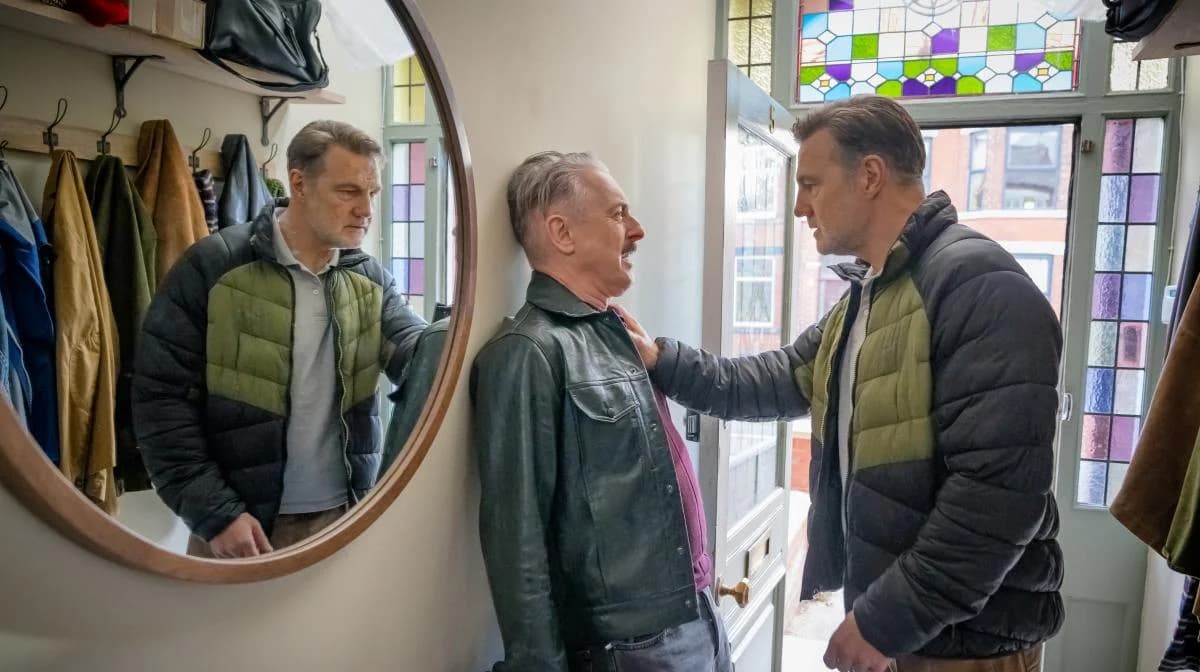
Image: Half Man (Series 1, Episode 4). Courtesy of BBC / Mam Tor Productions.
In this article
Spoilers for all six episodes of Half Man
There's a line in the fourth episode of Half Man that most people will have let pass.
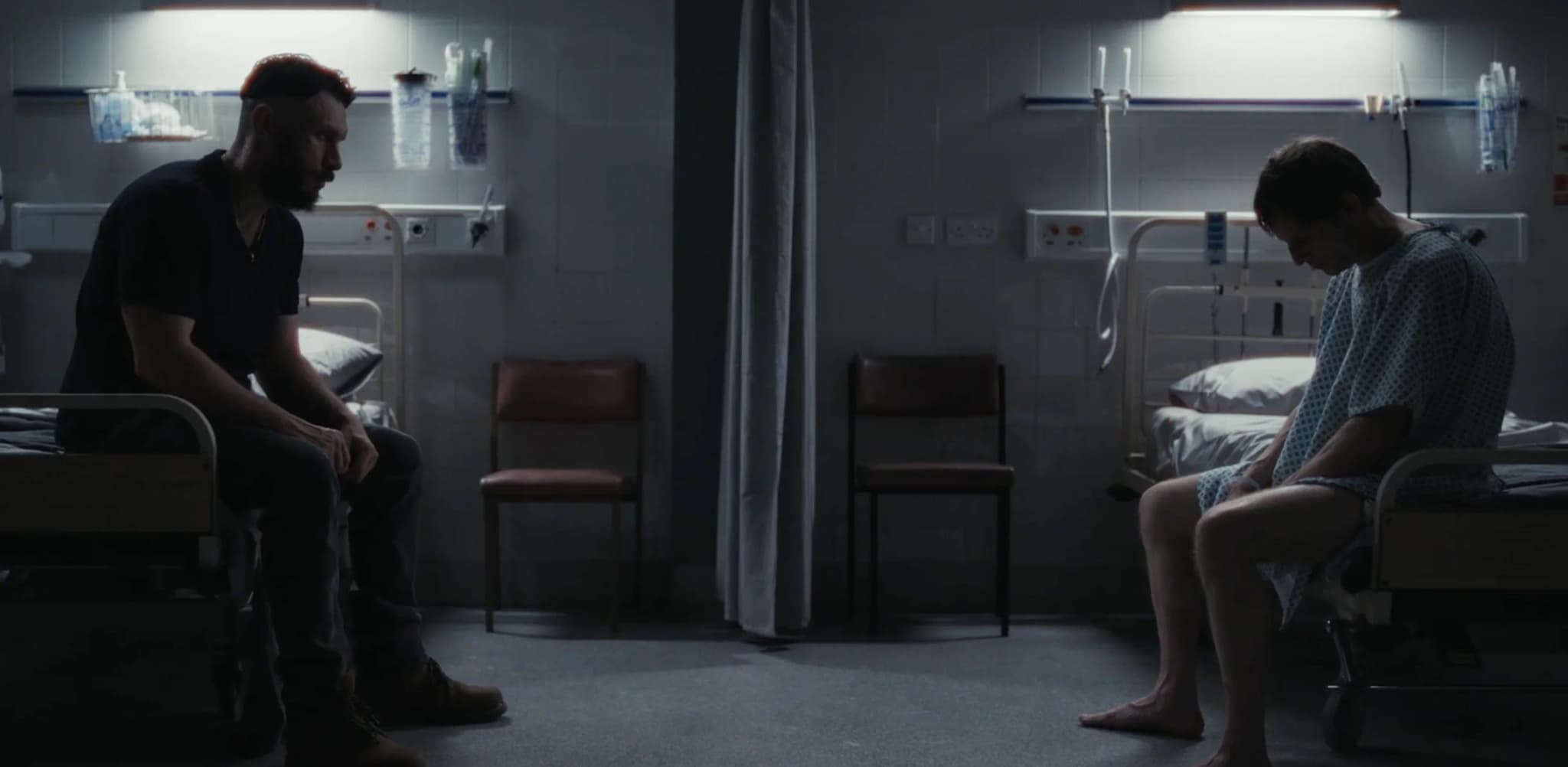
Ruben and Niall are in a hospital room, tearing into each other, fifteen years of it coming out at once. Niall has crashed a car after vandalising Ruben's. The scene goes from vicious to oddly tender and back again, and somewhere in the middle of it Ruben drops the line that anchors the whole series:
"You might be the painter, Niall, but I'm the rolling hills."
It sounds like a boast. Ruben does a lot of boasting. But it isn't quite an insult, and that's what makes it stay with you.
He isn't telling Niall he's nothing. He's telling Niall he's the surface, the clever rendering, the made thing, and that underneath the made thing is Ruben himself, the actual ground it was all taken from. The hills don't paint themselves. Someone has to stand in front of them and turn them into a picture. But the picture is of the hills. The hills were there first. The hills will be there after.
He has a point, and the show knows he has a point. Niall is a writer. The book that finally makes his name is about Ruben. The man who lived the life watches the man who watched the life turn it into something people admire, and the one who watched gets to be the artist while the one who actually bled stays the subject.
That's the grievance. It's real, and it's ugly, and anyone who has made something out of another person's pain knows the splinter in it.
Two halves of one man
A landscape doesn't know it's beautiful. It has no account of itself. It is simply the thing that is there, weather and rock and the events that happened on it, with no language wrapped around any of it.
That's Ruben. He is raw experience with nothing between him and it. The rage, the appetite, the abuse he took as a boy and the abuse he hands on, it all arrives in him unmediated, with no words to hold it at a distance. He doesn't reflect on his life. He is his life, happening.
Niall is the opposite missing piece. He has the equipment Ruben lacks, the capacity to take experience and turn it into form, into prose, into something you can hold up and look at. What he doesn't have is any experience he'll claim as his own. He's too busy fitting himself into whatever shape the room requires. So when he needs material, he reaches for Ruben's.
Neither of them can manage both parts of that experience alone. Raw material can't reflect on itself. Pure form has nothing of its own to give form to. A working mind does both. It has the experience and it can think about the experience, in the same head, at the same time. These two men have split that single capacity between them.
That is the half in Half Man. Two halves of one mind that never assembled inside a single body, rather than two men completing each other in a love story.
It's why they can't separate. Each is carrying a function the other needs in order to be a person at all. And it's why they can't survive together either, because a fusion has nowhere to grow. It can only tighten.
There's a reason Niall writes about Ruben rather than about himself. He can't paint the painter. His own life is the one subject he can't render, because he won't admit he has one. By the finale the show says this almost too plainly. In the prison visiting room, Ruben tells him he's spent his whole life dancing to other people's tunes and never had a rhythm of his own.
Watch what Niall does with his sexuality and you see the same thing from a different angle. When he finally tries to name it he can't land on the word, reaching for whichever one is tidiest rather than whichever one is true. The label was never the point. The point is that he wants to vanish into a shape, any shape, that lets him stop being the particular and difficult thing he actually is. He paints the hills because painting the painter would mean looking at himself, and there is nothing he's spent more effort avoiding.
The thing the painter made
The ending turns on the revelation that the child Ruben believed was his is in fact Niall's. Niall fathered him, in Ruben's life, and said nothing, and let Ruben raise the boy as his own.
Niall doesn't only render Ruben's life. He created a person inside it. The one thing Ruben was certain he had made, the proof that something of him would carry on, was not his at all. It was Niall's, made quietly, in Ruben's home, and concealed.
The painter creates. That's what painters do. We took the line as a remark about art, and it was always about more than art. Niall's creating runs along a single line from the safe kind to the unforgivable kind. The book is a theft of sorts, but Ruben can resent the book and still live. The child is the same act made flesh and made permanent. Niall reseeded the hills and let them believe the new growth was their own.
This is why the discovery sends Ruben into a rage he carries for years rather than minutes. It isn't ordinary jealousy. It's finding out that even his fatherhood, the floor under everything he thought he was, was something Niall made and hid.
And it recasts Niall entirely. We have spent six episodes reading him as the soft one, the one things happen to, the half who can only describe. But describing was never the only thing he did from underneath. He created a child in another man's life and stayed silent, which is the most consequential act in the show and also the most hidden, concealed the way the knife was concealed in his sock, the way the violence was always tucked inside the costume of the harmless man.
Two kinds of damage
Gadd has said he wanted to leave one question open: which of these two men does more damage. By the end he wanted you genuinely unable to say.
Ruben's violence is visible. The fists, the knife, the strangling leave no doubt about who has hurt whom. By the time Ruben learns the truth, he has built years of his life around the lie.
The two kinds of harm are difficult to compare. Ruben leaves people injured and frightened. Niall lets other people make decisions about their lives without knowing what he has done. The effects reach well beyond either man.
That difference also affects how we watch them. Niall reads as the victim for much of the series because we see what Ruben does to him long before we understand what Niall has concealed.
Alby and Benji
It happens twice, in the same shape, fifteen years apart.
The first time, it's Alby. At university Niall begins, tentatively, to come alive around him. Alby is the one person who sees what Niall is and won't say, and for a while Niall lets himself be seen. Then Ruben, unable to bear losing his place, beats Alby into a six-month coma and leaves his face permanently scarred. Ruben swings the fists. But the violence is organised around a secret that belongs to Niall, not to Ruben. Alby is destroyed for being the witness to the thing Niall couldn't own. The damage doesn't stay between the two brothers. It reaches a man who had nothing to do with their history and very nearly kills him.
In between the two, there's a courtroom, and it's worth pausing on, because it's where the easy reading of Niall breaks. When Alby presses charges, Ruben and both mothers lean on Niall to lie under oath, to say Alby provoked the attack and let a courtroom's prejudice do the rest. Niall refuses. He tells the truth, knowing it confirms Ruben's sentence and knowing what Ruben will do to him for it, and it costs him most of what comes after. So Niall isn't simply a coward who lets other people soak up the harm. He can stand up for Alby's truth. What he can't do, for the best part of his life, is own his own. That's the one truth that might have freed him, and it's the one he keeps.
The second time, it's Benji, and there's no frightened boy left to explain it away. Years on, Niall has slept with Mona, Ruben's wife, once, in Ruben's house. He's worn Ruben's dressing gown. And when Ruben finds the gown on his office floor and says it smells of another man, Niall, cornered, with his own exposure about to surface, hands him Benji instead. He'd already been quietly feeding Ruben's jealousy about the man for weeks. Now he aims it. Ruben goes and bashes Benji's head in, and goes to prison for it.
Look at what Niall does and doesn't do. He never throws a punch. He can't. But he can take the smell of his own body on another man's robe and turn it into a name, and point that name at someone barely known to him, so that the violence pointed at him lands somewhere else. And then, as Ruben goes to do it, Niall faints. He supplies the cause and his body switches him off before the consequence arrives. The painter authors the scene and isn't there when the paint dries.
The harm recurs whenever Niall faces exposure. Ruben is present for everything he does, fully inside it, no distance between the man and the act. Niall's harm always happens while he's looking away, including from himself. Alby, the gown, Benji, the child raised in another man's house. Each time, something that belongs to Niall gets redirected onto a third person who absorbs it for him. Niall makes a choice each time. He can't hold his own exposure, so he aims it at whoever's nearest and shuts his eyes.
Their actions depend on each other. Every one of these attacks is the pair of them together: Niall supplies what gets said or unsaid, Ruben supplies the boot, and neither produces it alone. Alby and Benji are casualties of the fused thing, not of either half of it. And the prison Ruben is sitting in when the whole reckoning finally comes, the painter and the hills, the child, all of it, is the prison Benji's beating put him in. Niall's redirection built the very room he would one day be undone in.
But the undoing, when it comes, starts as the pattern and then breaks it. Out on release for his mother's funeral, Ruben had caught Niall and Mona in a heated discussion and demanded to know what they were hiding. So when Niall comes to visit him in prison, the question is still hanging between them. Cornered, Niall does the familiar thing: he offers a secret to steer Ruben off the worse one. He tells Ruben he's gay. It's true, and it's a shield, a real piece of himself handed over precisely because it will satisfy the question and point away from Mona and the child. The redirect that has always used other men now uses the truth about himself.
And it works, but not the way he intends. Ruben, to Niall's surprise, just laughs it off. Then Ruben offers something back, the thing underneath everything: that his father abused him as a boy, that his body sometimes responded, and that the shame of it is what he's spent his whole life arming himself against. It's where he says the words the show is named after. Being used like that, he tells Niall, makes you a half man. The cornering is over. What replaces it is the closest thing to intimacy in the entire series, two men trading the secrets they'd kept, laughing at how little some of them mattered, finally seeing each other with the walls down.
And it's into that, not into the corner, that Niall lets the child slip. Cornered, he protects himself perfectly, as he always has. It's the warmth that undoes him. The pressure he can deflect; the intimacy he can't, and the secret he came in specifically to guard is the one that escapes the moment he no longer feels the need to guard it. The bystanders are all gone. There's no Alby, no Benji to take it. So it lands where it was always, finally, going to land.
The scene frustrates an expectation familiar from other stories. A scene of two men taking turns to confess their darkest things is supposed to be the breakthrough. It has the exact shape of healing. And Half Man makes it the fuse. The single moment of genuine mutual honesty is the thing the fusion cannot survive. What they disclose brings the relationship apart.
The locked door
The final collapse happens on both of them, in the same room.
At the wedding, Ruben locks them into the barn. While he is strangling Niall, Niall reaches the knife in his sock and puts it into Ruben's side. We watch Niall die. We never see Ruben die. The fifth episode has already shown us his body, so the outcome isn't in doubt, but the final episode declines to show the act itself, and what fills that gap is the worst possibility. Stabbed but not fatally, with a wedding's worth of people on the other side of a door he chose to lock, Ruben lets himself bleed out beside the man he has just killed.
Look at the symmetry the show builds and then hides. Niall's one decisive act in six episodes is the blade in the sock, and even that is reactive, done from underneath, while being strangled, with a weapon kept hidden inside his formalwear. His single moment of agency is self-defence concealed in the uniform of belonging. Ruben's last act is the lock. One kills. One refuses to be saved. Between them they make certain there is no version of the story where one walks out and the other does not.
Two halves of one ruined structure, collapsing inward at the same time, both inside the room, the door shut from within. That is what the barn is.
And notice what the show will not let you see. It will not show you Ruben dying. Gadd has said the question he's asked more than any other is what the final sound Ruben makes means, and he won't answer it. The two withheld things are both Ruben's, and both are the moments where a lesser show would let you watch one man end as something separate from the other. Refusing to show them keeps the two of them fused right through to the cut to black. You are not allowed to see either man die alone, because in the logic the show has been building since that hospital room, neither of them does.
What it leaves you with
It would be easy to want a kinder ending for them. Some version where the prison scene is the turn, where two men finally saying the unsayable to each other is the start of something rather than the end of both of them. The shape of that scene promises it. We have been trained by a hundred other stories to expect that the confession heals.
The show refuses, and it's right to. It has spent six episodes showing you why the healing can't come, and the refusal is the most honest thing in it.
Underneath all of it is a story about what happens to a man who never builds a whole self on the inside, and goes looking for the missing half in another person. Who keeps his experience out there, in someone else, because he has no language for it in here. Who would rather be the painter, or the hills, than do the harder thing, which is to be the whole landscape and the one who can look at it, in the same body, alone.
That arrangement can feel like love. It can feel like the most important relationship of your life. It is also the thing that ends, eventually, in a locked room.
Most of us are not Niall or Ruben. But a great many people are carrying half a mind around and looking for the other half in a partner, a parent, a brother, someone to hold the feelings they can't hold themselves. The work, if there's work, is slow and unspectacular. It's the business of getting the painter and the hills back into one person. Of learning to have your own experience and to put your own words around it, so you don't have to keep handing one half of yourself to someone who might, one day, lock the door.