Tip Toe Ending Explained: How a Neighbour Becomes a Monster
Russell T Davies' Tip Toe ends in a killing everyone saw coming. The harder thing is how an ordinary neighbour became a monster in another man's mind.
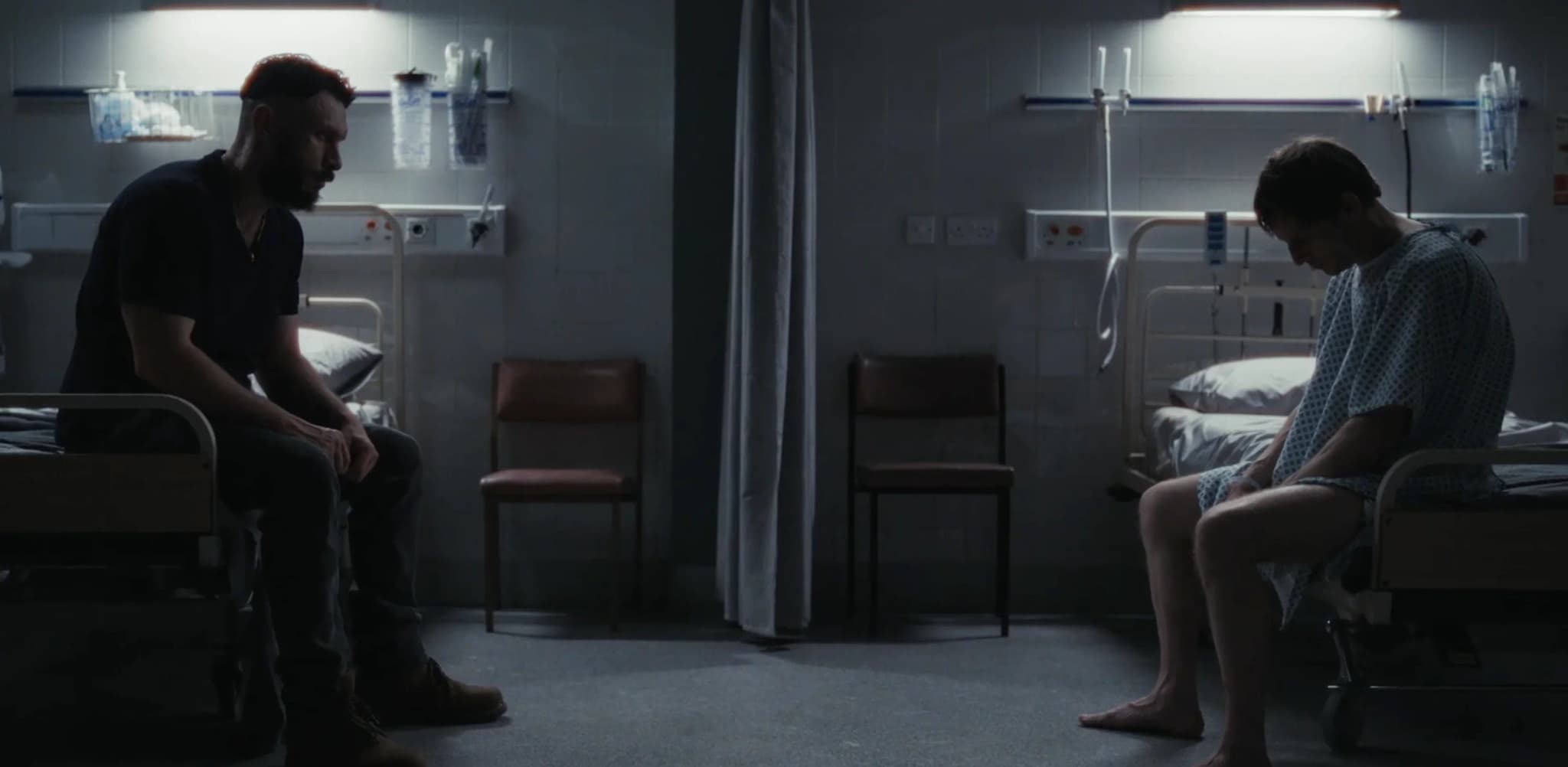
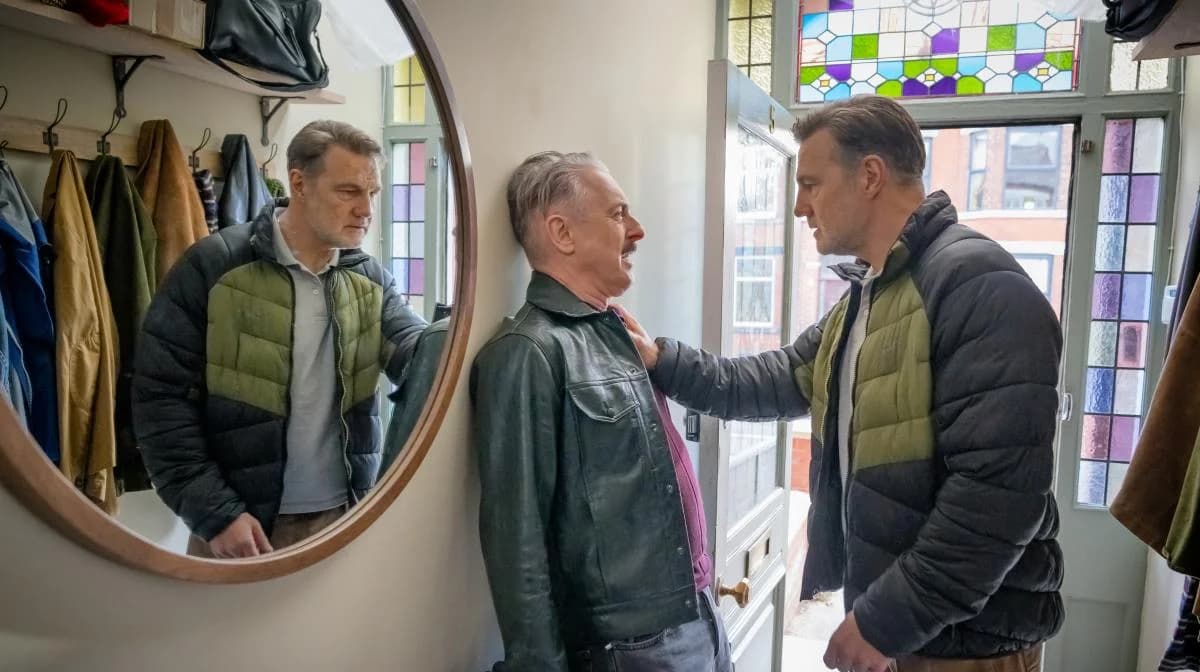
Alan Cumming and David Morrissey in Tip Toe. (Image Credit: Channel 4)
In this article
Spoilers for Tip Toe (Channel 4), all five episodes.
For fourteen years, Clive Goss nodded at his neighbour in the morning and thought nothing of it.
The violence at the end is not the mystery. Tip Toe gives you the aftermath in its first minute and keeps returning to it: a man hanging from a lamppost, the outcome without the scene that made it possible. The knowing does not help. If anything, it makes the horror worse, because what the show withholds is the familiar part: the way a room can turn before anyone has admitted it has turned, the way a joke becomes permission, the way ordinary life keeps carrying on while something terrible is already assembling inside it. When the scene finally comes, whole, it is worse than anything the aftermath lets you brace for. The mystery is the fourteen years of nothing before that final scene: a man and the man next door, sharing a wall and a street and a postman, getting on the way neighbours get on, which is to say barely and pleasantly and without much thought. Leo Struthers ran the Spit & Polish on Canal Street. Clive fixed people's wiring and raised his sons.
For fourteen years, nothing happened. And then it did.
Played one way, this is a story about a bigot. Clive is uncomfortable that Leo is gay. The discomfort hardens, a favour goes wrong, words turn into weapons, and a man finds out what he is capable of. Told like that it would be a public information film, the kind that flatters you for already agreeing with it.
Davies is not interested in flattering you, and Clive is not a man who was always going to do this. That is the harder thing the show is about. Nothing in Clive changed. The weather did.
The weather changed
Behaviour is not fixed. It depends on what the world around it will allow.
The tensions rising around the country in Tip Toe are not set dressing. They are a change in the rules. They tell a man what he is now permitted to feel, then what he is permitted to say, and eventually what he is permitted to do. Clive does not acquire a new hatred. He discovers that an old one, folded away for years and never acted on, is suddenly allowed out.
Freud thought the civilised part of us, the part that holds our aggression in check, was thinner than we like to believe and largely on loan. We borrow our restraint from the group. When the group withdraws it, when it starts to signal that this person, or this kind of person, is fair game, the restraint goes, and the people who were already holding something down do not so much turn cruel as get released into what was waiting in them.
This is the show refusing to hand us a monster from outside ordinary life. There is only permission, and what ordinary people do with it once they have it.
What he couldn't keep down
But permitted to do what, exactly? Permission only matters if there is something being held back.
And there is. The question the show keeps asking, under its breath, is not why Clive hates, but why now, and why Leo. The answer is not out in the country. It is in Clive.
What returns when the weather changes is what Clive spent a life pushing down, and Davies shows it to us directly, in a scene most writers would have left implied. There is a night, after Clive has punched a man for going at a drag queen in the Spit & Polish, defending her without quite asking himself why it matters so much, when he sits at home and watches her perform on his phone. His hand moves under the duvet. And then it stops.
The easy thing is to file that scene and move on: so he is really gay, and the hatred was a closet all along. Davies will not let you off that lightly. What the scene shows is repression happening in real time, in a man's own hand. The wanting rises and Clive puts it back down himself. Nobody is making him do that. He is the one who stops.
And desire is only one of the things he has exiled. Naming it as the single hidden cause is its own way of tidying him up. There is also the tenderness, the need, the wish to be looked after, the fear of getting old on his own, all of it being lived out next door, in full view, by a man of nearly sixty whose own long relationship has just ended. To Clive, Leo is living openly everything Clive forbade himself. You cannot watch that across a shared wall for fourteen years without it turning into something.
The something is envy. Not the wish to possess what another person has, but the wish to spoil it because they have it. Whether Clive wants Leo's openness for himself is almost beside the point. He refused it himself, under his own duvet, and what he cannot bear is that Leo has it at all, so it has to come down. Envy is the feeling we are quickest to disown by planting it in someone else, which is the move we have already watched him make with the disgust. The man who stops his own hand cannot forgive the man who never learned to.
Clive's wanting has an address, and it is the Spit & Polish: Leo's bar, Leo's stage, the room where the thing he cannot allow himself gets up and performs. He cannot touch the want, so he turns on the man who keeps the door to it. Freud called this the return of the repressed: what you bury comes back from the outside, wearing someone else's face, so you can fight it as if it were not yours.
And then there is the key.
Davies builds the whole thing on a spare key. Leo hands one over, an ordinary neighbourly favour, and that is where the rot begins. The repressed is let back in through the door. Not as a metaphor. Literally, by invitation, as an act of trust. Leo was tolerable for as long as he stayed at the threshold: a face in the morning, a man on the other side of the wall. The favour brought him inside. And what came in with him was everything Clive had exiled.
The man made to carry it
Clive does not only hate Leo. He uses him. Everything he cannot hold in himself, the disgust, the fear, the desire, the failure to be a father his gay son can talk to, he puts into Leo and treats Leo as though it began there. The mess is no longer inside Clive. It is next door now, and a thing with a face can be fought.
The consulting room has a name for this, projective identification, and the second half of the phrase is the part that matters. The projection goes out looking for evidence, and Leo, without meaning anything wrong, keeps handing it over. George, Clive's sixteen-year-old, is gay and frightened of his father. Leo, who is gay and kind and constitutionally unable to leave a frightened person alone, reaches for the boy. He sends a voice note: you are not alone, there is a whole life waiting for you. It is an act of plain decency, the reassurance Clive cannot give his own son. It is also, from a man of nearly sixty to a boy of sixteen, badly misjudged, the kind of message that curdles the instant it is read by someone looking for a weapon. Both are true at once. That is the trap, and it is merciless.
Leo cannot do right for doing wrong. The kindness becomes the evidence. The fact that he is the gay man George turned to, instead of his own father, becomes the evidence. Clive does not have to invent a predator. He has only to find the voice note and read it through the oldest lie there is, the one that says a gay man who is gentle with a boy must be working up to something. There. I always knew.
Everything Clive is so frightened of is already inside his own house: a grown son selling himself online, a youngest son gay and hiding from him. None of it is Leo's doing, but a man cannot fight what is under his own roof, so he plants it next door instead.
We call this a feud because feud is a comfortable word: two men, both at fault, a quarrel that ran away with them. It is not a feud. A feud has two sides. This is one man building a monster out of another, and a handful of others willing, when it came to it, to help him kill it.
Because Leo never becomes the thing he is accused of. He stays who he was, warm and decent and a little careless, to the end. It never had to be true: projection does not need its target to cooperate, only to exist, with the weather turned and some innocent piece of him that can be lifted into the light and called a crime. And when he tries to answer it, to apologise, to explain, every move pulls the net tighter, because to people who have already decided, an apology is a confession and an explanation is a cover story. Anyone who has been made to carry another person's disowned self knows that exact helplessness: the more reasonably you answer, the guiltier you look.
How a living room becomes a mob
You would expect a killing like this to need a mob: a square full of torches, a town that had always hated him. It does not. It needs a living room.
Saul, Clive's elder son, has the lads round to watch the football, and the afternoon is the ordinary poison of a certain kind of male room. Banter that is really testing. Jokes that are really threats. George, the sixteen-year-old, picked over while the men laugh. One of them, Roddy, is the engine of it, the boy whose gift is finding the soft place and pressing on it. None of it is planned. It is a mood, and the mood keeps climbing, each remark a step past the last, no one quite the one who started it.
In that room, each man goes further than he might have gone alone. As the others join in, responsibility becomes easier to evade. That is what lets it feel allowed: the restraint Freud said we keep on loan from the group, called in by the group itself, in person, in a front room. And the permission did not start there either. It is the same air the whole country has been breathing all year, the rhetoric that had quietly slid gay men, and then trans people, back into the old category of danger to children. Clive did not invent it. Neither did the lads. They breathed it in, and on one afternoon, with enough drink and enough goading, it found something to do.
The rest of the street is no part of this. Most people are not thinking what Clive is thinking, and Leo's own, the staff from his bar, are the ones who come running to help. That is the truer horror, and the smaller, nastier one. It did not take a town that hated him. It took a handful of ordinary men, a long afternoon, and a country that had told them it was allowed.
No one could stop it
Leo goes round because he is worried about George, hoping to help and lower the temperature, and he walks into a room already alight. Clive takes his phone and will not give it back. What tips it is not the paedophile rumour alone. It is a name. The lads find a name playfully scrawled on George's back from a night out, Flo, and in it Clive reads the worst thing his own terror can imagine: that they are not just corrupting his boy but changing him, turning him into a girl, that this is the road, in Clive's mind, to his son being cut. The old slander and the new one fuse. Leo's HIV pills become infection, become filth. And as Clive takes hold of him, breathing on him, using his fist, Leo says the truest line in the show: that he cannot tell, in the end, which one of them is the gay one.
Then they take Leo out to the lamppost, and they hang him, and Clive directs it. Over the noise he makes a speech. The street needs a new flag, he says, to show that it is safe, that its children are safe, that there is one place left in the world where children are safe, and that flag is Leo's body. He is not raving. He believes he is performing a civic duty. And the whole time it is Saul, his elder son, the one whose mates are doing the killing, who is screaming at him to stop, to let Leo go, please, Dad, please.
The hardest thing about the show is that the ending feels true. There is no single villain whose removal would have saved everyone. The killing was shared out, Clive's and the lads' together: ordinary people who took the permission they were given.
When it is over, the lads scatter, and Clive is left standing in the road beneath the body. His wife, Marie, reaches him and beats at him, asking what he has done, over and over, a question with no floor beneath it: grief, arriving before the words for it.
Clive has no such question. As he walks away from it, one of Leo's own screams murderer at his back, and when he reaches the police he tells them it was no murder. It was an execution. Two names for one act, and the truer one comes from the people the act was meant to frighten. The frightening thing is that Clive is not lying, not to them and not to himself. An execution needs a crime, a sentence, a guilty man, and to him all three are real. In his own mind he kept the children safe, and that is what the projection was always for. You cannot execute a neighbour. You can only execute a monster, and so the monster had to be built first.
The show does not end on the body. It ends on a screen of text, the way these things now get settled. In the months after his death Leo's story keeps changing, the record rewriting itself, until within eighteen months a search for Leo Struthers returns the words convicted paedophile. He was never charged. There was no crime, no trial, no conviction. There was a lie, and a record that hardened around it. The monster outlived the man. The lie is the last of him.
For fourteen years, nothing happened.
That was never safety. It was only the weather holding.