Louis Theroux in Inside the Manosphere. (Image Credit: Netflix)
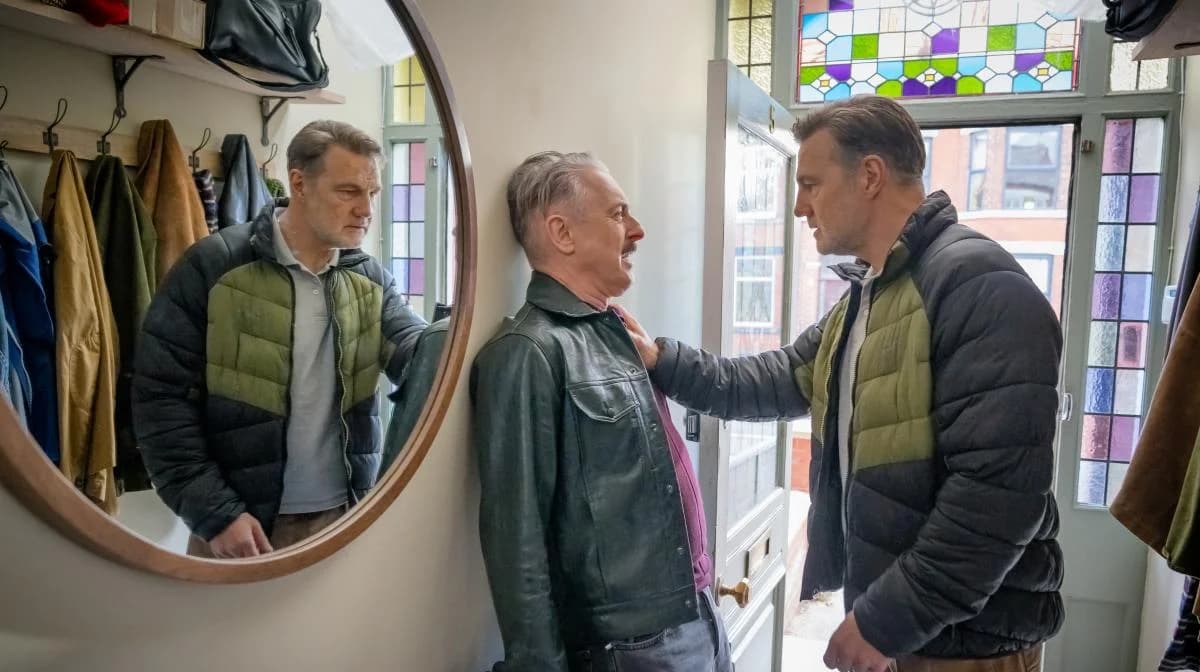
In Inside the Manosphere, the men repeatedly supervise Louis Theroux's conversations with the women in their lives.
He wants to interview Myron Gaines' girlfriend. He wants to talk to Gaines' booker, Icy - the woman who recruits female guests for a podcast that profits from contempt for women. When he visits Justin Waller's home, he meets Waller's wife.
Every time, access is managed. Interviews are supervised. The women are present, but never quite available.
These are men who publicly perform total dominance. Women should not vote. Women are, in one memorable formulation, dishwashers. Male authority is simply the natural order, and any man who hasn't claimed his place in it is weak and failing.
And then Louis tries to speak to a woman alone, and the man inserts himself.
Watch Gaines' face in the moment Louis disappears to go and speak to Icy privately. There's a flicker - something that moves through him very quickly before the composure reassembles. Not anger. Not disdain. Something closer to panic. The face of someone who has just understood that something important might slip out of his control, and has to manage that without appearing to manage it.
This is not the behaviour of someone who is genuinely indifferent to women's opinions. Indifference doesn't require supervision. The controlled access is evidence of something else entirely: an acute anxiety about what the women might say if no one was watching. A need for their compliance that cannot be directly acknowledged, because to acknowledge it would collapse the entire structure.
The performance of dominance requires the audience to cooperate. If Gaines' girlfriend had spoken freely - if she'd expressed ambivalence, or said something that didn't fit the script - the mythology punctures. The control isn't incidental to the ideology. It's the seam where the ideology fails.
The men's accounts of their childhoods suggest another way of reading this behaviour.
Harrison Sullivan's father, England rugby player Victor Ubogu, left when Harrison was young. Sullivan was raised by a progressive, present mother who, by his own account, hates sexism, racism and homophobia. Justin Waller grew up between a trailer park and foster homes, his father mostly absent. The pattern repeats across almost every man in the film.
This matters because the ideology they're selling is, at its core, a fantasy of paternal authority. Not authority they experienced, but authority assembled from absence. The hyper-masculine ideal - dominant, wealthy, sexually powerful, answerable to no one - is built from imagination, not memory. There was no real man modelling this. There was only the gap where a man should have been.
Harrison Sullivan provides one example. There's footage from a livestream in which Harrison and his mother are bickering. It's uncomfortable viewing, but not for the reasons you might expect. What's striking isn't the conflict. It's how familiar it looks. Two people locked in an old argument that has no resolution, playing out the same positions they've probably played out a hundred times. She challenges him; he performs exasperation; neither of them can reach the other.
This is the relationship the entire ideology is built on top of. Not a bad mother and a wounded son - a mother and son who never found a way through their differences, and a son who eventually found a community that told him the differences were her fault. She embodies everything the manosphere despises: progressive, present, opinionated. His father is a famous, physically powerful man who disappeared. And Harrison constructs an identity around contempt for his mother's values and worship of the kind of dominance his father represented from a distance.
His attacks on women can also be read in the context of that early conflict. He appears to side with the father who left over the mother who stayed. The ideology gives that a political frame, and a revenue stream.
Gaines runs a podcast that monetises female degradation. Icy is the woman who keeps it running - recruiting female guests, managing access, doing the work that makes the whole enterprise function. The business that profits from misogyny is structurally dependent on female labour. This dependency isn't hidden. It's built in.
Gaines cannot see this, or cannot afford to. The ideology requires women to be contemptible and peripheral. The business requires them to be essential. He holds both simultaneously and the contradiction goes unexamined - which is, in itself, a kind of performance. The ideology doesn't have to be coherent. It only has to be useful.
If the creators of this content are trapped in a performance, the men who consume it are trapped in something much darker.
The most affecting parts of the documentary are not the influencers. They're the men who follow them.
One fan tells Theroux he'd been homeless for a period following his brother's suicide. He credits the hustle-culture content with giving him something to hold onto. It's easy to be contemptuous of this, and it would be a mistake.
The manosphere does not primarily capture men who are doing well. It captures men at their most broken - in grief, in failure, in the specific despair of feeling like everyone else knows something you don't. What the ideology offers is a conversion of the unbearable internal state: I am failing, I am lost, I am in pain becomes the system is broken, feminism is the problem, women did this. The wound moves from inside you to outside you. That's not stupidity. That's a psychologically coherent way of making suffering more tolerable.
The tragedy is that it forecloses the possibility of actually working through anything. Once the pain belongs to the enemy, it can't be yours. You can't grieve it, or understand it, or let it change you. You can only keep the enemy in view.
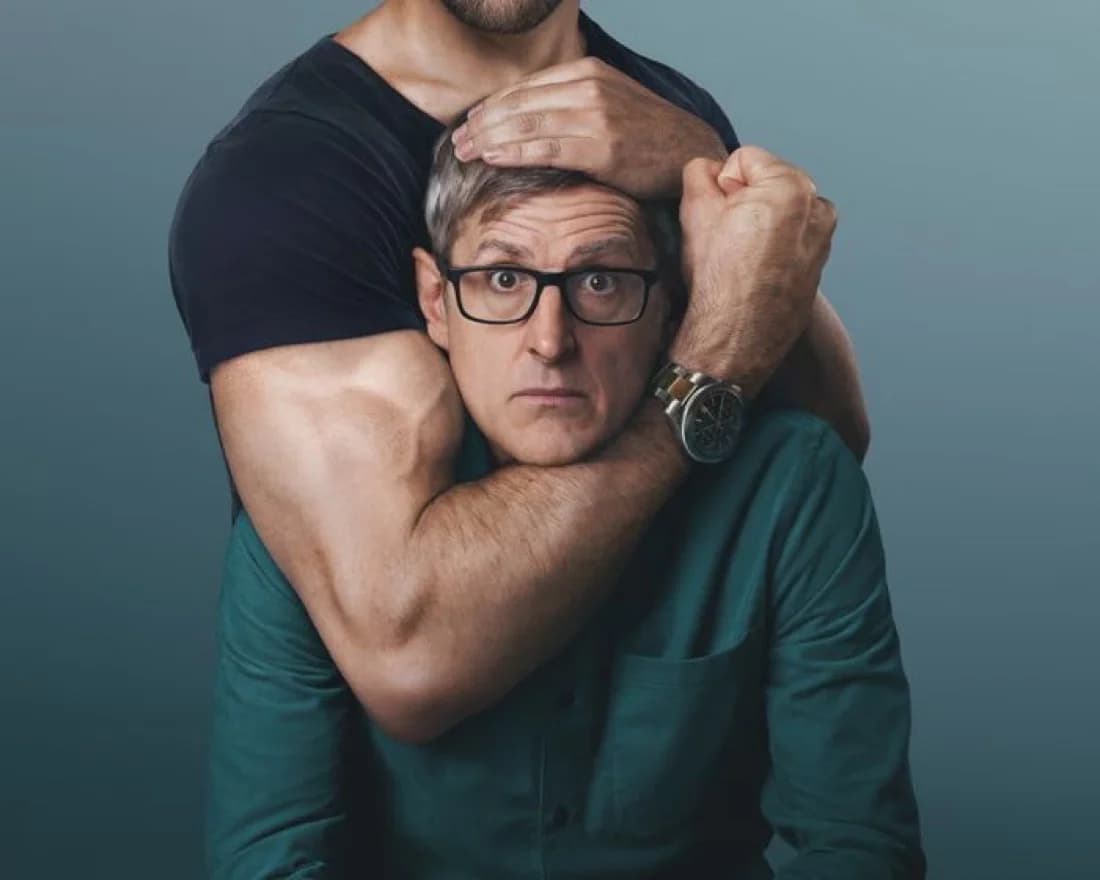
Louis Theroux is a notable presence in his own documentary, not just as the interviewer but as an argument.
He is, by the manosphere's taxonomy, a failure. Slight, bespectacled, older, not visibly wealthy or physically dominant. He describes himself, with characteristic precision, as a skinny older primate who's probably not handy in a scrap. He is the thing these men define themselves against.
He is also clearly fine. Comfortable in himself, genuinely curious, not performing anything. He has a marriage that appears functional, children, a long career built on the quality of his attention rather than the size of his presence.
The attempts to destabilise him - the Jimmy Savile ambush, the live streaming, the manufactured confrontations - are attempts to remove him as a living counterexample. If you can make Louis look rattled, you restore the framework. If you can't, the framework has a problem.
They couldn't make him look rattled. The framework has a problem.
The documentary gets described as an exposé of misogyny, which it is. But watching the Netflix documentary through a psychodynamic lens, what you're actually seeing is something more specific: grief wearing the costume of ideology.
The absent fathers. The contempt for the women who stayed. The obsessive control of women in private while degrading them in public. The dependency on female labour and female compliance that can never be named directly. None of this is the psychology of men who have worked through their attachment history. It's the psychology of men who haven't been allowed to, and who found a community that converts the wound into a worldview.
The ideology is doing important psychological work for the men inside it. It's organising unbearable feelings into something with a target and a solution. That doesn't make it less harmful. But it does explain why simply arguing against it - presenting counter-evidence, pointing out hypocrisy - changes nothing. You cannot dismantle a defence mechanism by proving it wrong. You can only make it more rigid.
The supervised interviews troubled me most. The men kept inserting themselves when Louis tried to speak to the women in their lives. To me, that behaviour suggests anxiety about what the women might say beyond their supervision. Their claims of dominance sit uneasily beside that need to control the conversation.