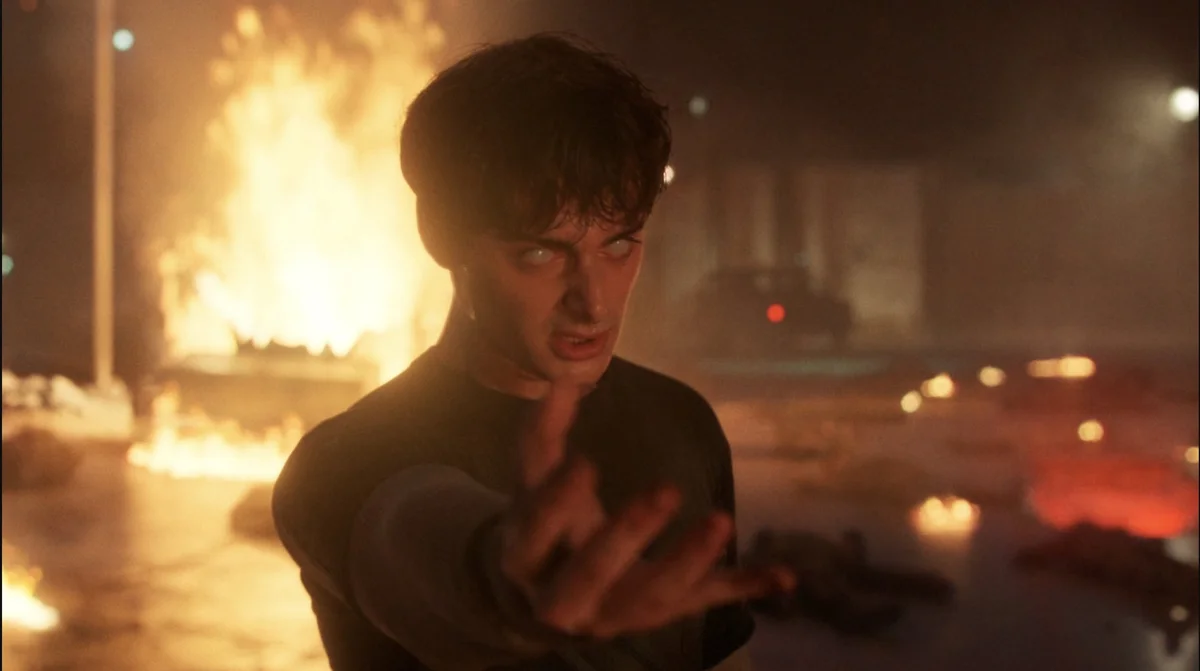
Will Byers in Stranger Things Season 5, Episode 4. (Image Credit: Netflix)
The sensitive kid never gets to be the hero.
They feel too much, notice too much, carry everyone's anxiety in their body before a word is spoken. So they learn to hide it. Perform capability. Let others have the big moments while they manage feelings from the background. They tell themselves this is safer. That sensitivity is weakness, and weakness gets you killed.
Then something breaks them open anyway, and the wound becomes the weapon.
This is Will Byers in Episode 4 of Stranger Things Season 5. The boy who's spent four seasons being possessed finally learns to possess back.
For four seasons, Will has been Stranger Things' designated victim.
Taken to the Upside Down. Possessed by the Mind Flayer. Rescued, recovered, sidelined. While Eleven throws vans and closes gates, Will draws pictures and gets that look on his face - the one that says it's coming - and waits for someone with actual power to do something about it.
He's the soft one. The liability. The reason everyone else has to be brave.
The show knows this. It's used his vulnerability as emotional stakes while giving the heroism to others. And if you've ever been the sensitive kid in a group - the one who felt things first but couldn't fight - you've probably watched Will with a complicated kind of recognition. Part sympathy. Part frustration. Part please, just once, let him matter.
Episode 4 is called "Sorcerer."
His nose starts bleeding.
If you know what nosebleeds mean in this universe, you understand immediately: Will isn't being invaded anymore. He's channelling. The thing that's been possessing him for four seasons - the open wound, the infection that never healed - he's using it.
For once, Will can act on the danger he senses.
Will Byers has something in common with Harry Potter. Both boys are marked by an encounter with an enemy, and the mark becomes a connection they can use.
Both boys are marked by their encounter with evil. Harry's lightning scar burns when Voldemort is near. Will's neck prickles when the Upside Down bleeds through. Both wounds are infections that never fully healed - damage that left a channel open between the boy and the monster.
For years, both experienced this connection as a curse. Something shameful. Evidence of contamination. Harry's scar brought visions he didn't want, pain he couldn't control, the creeping knowledge that something of Voldemort lived inside him. Will's sensitivity made him a liability - the early warning system nobody wanted to be.
Jung called this the Wounded Healer.
The shaman who nearly died of illness and came back able to heal. The therapist whose own breakdown taught them what textbooks never could. The person whose gifts emerge not despite their trauma but through it.
Harry's scar connects him to Voldemort. Will's infection connects him to the Hive Mind. Both connections give the boys knowledge they would rather not have.
The only question was whether they'd learn to use it - or keep being ashamed of what they carried.
Voldemort and Vecna each share something with the hero who opposes them.
In Jungian terms, the Shadow is everything you've refused to face. The parts exiled because they felt too dangerous, too shameful, too incompatible with who you're supposed to be. The Shadow doesn't disappear when ignored. It gets projected onto monsters. It returns wearing someone else's face.
Tom Riddle chose power over love. Henry Creel chose domination over vulnerability. Both are what their respective heroes could have become - the sensitive boy who decided that if the world couldn't accept him, he'd unmake it.
The cruel irony: both villains tried to kill the hero as a child. Both accidentally transferred part of themselves into their victim. Voldemort created a Horcrux he never intended. The Mind Flayer left a particle inside Will that never fully left.
They made their own destroyers.
The monster you're fighting is always, in some sense, the part of yourself you refused to face. That's why Harry had to walk into the forest and surrender. The Horcrux inside him could only be unmade through acceptance, not combat.
Will may face a similar choice.
There's a reason the Duffer Brothers called Episode 4 "Sorcerer."
In D&D, wizards learn magic through study. They earn their power through discipline, through external mastery. Sorcerers are different. Magic runs in their blood whether they want it or not. They don't choose their power. They only choose what to do with it.
Eleven is a wizard. Her abilities were trained into her, cultivated in a laboratory, refined through practice. She's powerful because she was made to be.
Will is a sorcerer. The power is in him because something terrible put it there. He didn't ask for it. He can't remove it. For four seasons he's treated it as contamination - evidence of his brokenness, the thing that makes him weak while others are strong.
In Episode 4, he stops fighting it.
That's what the nosebleed means. He's not being invaded by the Hive Mind anymore. He's wielding it. The channel that's been a liability for four seasons just became a weapon. The boy who could only warn people that danger was coming can now do something about it.
Jung called this Individuation: the integration of the Shadow rather than its exile. You don't become whole by cutting away the dark parts of yourself. You become whole by acknowledging they're yours - that the monster and the hero are both you, and the only way forward is through.
Will accepting the Sorcerer title is Will accepting that he's tainted. And that the taint is precisely what makes him powerful enough to fight.
Neither can live while the other survives.
Will carries a piece of Vecna inside him. A particle of the Mind Flayer. A fragment of the Upside Down that's been his backdoor vulnerability for four seasons - the way the monster keeps getting in.
But backdoors work both ways.
Harry couldn't defeat Voldemort through superior magic. He had to stop resisting the connection between them and walk directly through it. Trust that what waited on the other side would destroy the Dark Lord rather than himself. The killing curse that should have ended him became the thing that saved everyone else.
That parallel suggests one possible ending for Will. He might have to enter the Upside Down and use his connection to sever it from inside, putting himself at risk in the process.
From the outside, it will probably look like death.
Whether it actually is depends on how closely the Duffers follow the archetype - and whether they understand that the Wounded Healer doesn't heal by staying wounded. The final step of the journey is using the wound to close the wound. Becoming whole by finally letting go of the thing that's defined you.
Shame is central to this reading of the Wounded Healer.
Will Byers carried his infection like a secret - evidence he was contaminated, damaged, less than. The thing that happened to him in the Upside Down marked him permanently, and for four seasons he experienced that mark as disqualification. He couldn't be the hero because heroes aren't tainted. Heroes aren't the ones things happen to.
Harry Potter felt this too. The scar wasn't just a connection to Voldemort - it was proof something of the Dark Lord lived inside him. The visions, the Parseltongue, the moments when he felt Voldemort's rage as his own. He spent seven years terrified he was secretly one of them.
For Will, using the connection means reconsidering something he has experienced only as damage.
Not because suffering is noble or trauma builds character. But because the specific ways we've been broken open are often the specific ways we can reach places others can't. The wound isn't the qualification. The willingness to stop hiding it is.
Will begins to use the connection he has spent four seasons trying to conceal. He can act without first becoming someone untouched by what happened to him.
The sensitive boy saves everyone not by becoming tough, but by accepting he never needed to be.