Your GP mentioned "talking therapies" and handed you a leaflet. The NHS website has reassuring language about "evidence-based psychological therapies." You're trying to work out what you've actually signed up for.
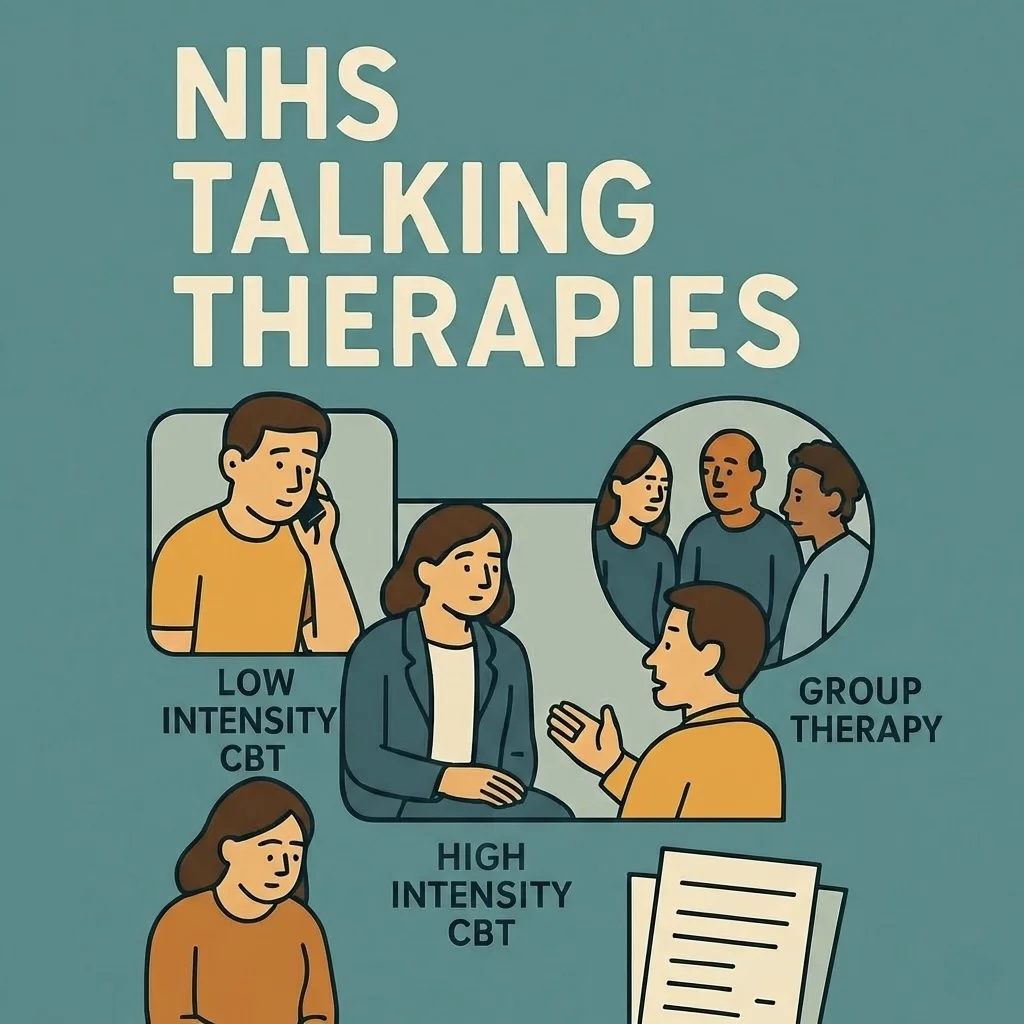
Here's what Croydon Talking Therapies actually offers:
-
Low intensity CBT: 3-6 sessions, usually online or over the phone
-
High intensity CBT: 6-12 sessions if you score high enough on their measures
-
Counselling: 6 sessions maximum (provided by Care To Listen)
-
Group therapy: Eight weeks sharing your struggles with strangers
-
Guided self-help: CBT worksheets you do alone
For many people, that is the practical menu for South London's mental health provision through IAPT (Improving Access to Psychological Therapies), now rebranded as NHS Talking Therapies.
"Talking therapies" sounds comprehensive, doesn't it? Like there's real choice available. In practice, it often means cognitive behavioural therapy in various doses.
When Croydon Talking Therapies says "evidence-based treatment," it usually points toward:
-
CBT (the main offering)
-
Guided self-help (CBT you do yourself)
-
Behavioural activation (CBT focused on activity)
-
Group CBT (CBT with witnesses)
-
Six sessions of counselling (sometimes enough to begin, not always enough to work deeply)
What they don't mean is choice. What they don't mean is depth. What they don't mean is time to understand why you're here again.
Published access figures can make the pathway sound faster than it feels. But "access" often means your initial assessment, not treatment. And if you need high-intensity CBT rather than guided self-help, you may wait longer. If you score just below their thresholds, you might not qualify at all.
CBT dominates NHS provision partly because it fits the system's needs: it is structured, measurable, and scalable. South London and Maudsley Trust, which oversees mental health services in Croydon, treats over 45,000 people annually through IAPT. That's a lot of people entering a broadly standardised pathway, whatever brought them there.
The same worksheets. The same thought diaries. The same six sessions.
CBT is measurable, manualised, and well suited to short, structured symptom work. It can work well for specific, surface-level symptoms - panic attacks with clear triggers, specific phobias, recent depression with obvious causes. For these issues, six sessions might help.
But here's what it may not reach: the patterns that keep bringing you back.
Here's the reality of those six sessions you waited seven months for:
Session 1: Assessment and goal-setting. You explain your entire history in 50 minutes. The therapist types while you talk.
Session 2: Psychoeducation. You learn about the CBT model. You're given your first thought diary.
Session 3-5: Technique practice. You challenge thoughts, test behaviours, fill in worksheets. The therapist checks you're doing it "right."
Session 6: Relapse prevention and discharge. You're given a folder of worksheets and wished well.
Months later, you might be back at your GP. Same anxiety, different trigger. Same depression, deeper this time. Same relationship patterns, new person.
The GP refers you back to Croydon Talking Therapies. Another assessment. Another six sessions. Another folder of worksheets you'll never look at again.
Eight sessions isn't enough for complex emotional patterns. In Croydon, you get even less.
Consider someone who repeatedly ends up with critical bosses, experiencing "generalised anxiety" at every job. They get referred for CBT. They learn breathing exercises. They challenge their thoughts. The anxiety returns with the next job.
What if the anxiety isn't the whole problem? What if they're unconsciously choosing critical authority figures because criticism feels familiar - like home, like love, like what they know? The anxiety might be their nervous system recognising danger in patterns they keep recreating.
Six sessions of CBT may not get far with this. How could it? The pattern is unconscious. The anxiety may be the symptom, not the whole problem.
This is what's missing from NHS provision:
Psychodynamic therapy explores these unconscious patterns. It asks not just "how can you manage this anxiety?" but "why do you keep ending up in situations that make you anxious?"
Humanistic approaches focus on who you are beyond your symptoms, your capacity for growth that's been blocked.
Systemic therapy looks at the relationship dynamics keeping you stuck.
None of these are available through IAPT Croydon or through Mind in Croydon's NHS-funded services. Not necessarily because they lack value, but because they don't fit easily into six sessions, weekly questionnaires, or worksheets.
While the NHS does offer psychodynamic therapy for severe cases through secondary care (CIPTS), this is extremely difficult to access. For the average person engaging with Croydon Talking Therapies, these options are simply not on the table.
The waiting list might be 6 weeks or 18 weeks, depending on what you need and when you ask. In that time, life may have moved on and the pattern may have repeated.
Private therapy in South London typically costs between £60-120 per session. Expensive? Consider the real cost of staying stuck:
-
The relationship that strains while you're waiting for help
-
The work decisions you make while anxiety is becoming unbearable
-
The patterns you may keep carrying because you never had time to understand your own
The question isn't only whether you can afford private therapy. It's what it costs to keep managing symptoms while the roots remain untouched.
Psychodynamic therapy doesn't rely on weekly questionnaire scores as the whole measure of progress. It doesn't discharge you after six sessions because that's all the funding allows. It doesn't reduce your depression to a thinking error or your anxiety to a breathing problem.
Depth therapy takes time. Time to build trust. Time to notice patterns. Time to understand not just what you do, but why you do it. Time to experience yourself differently in relationship.
When therapy can continue weekly for as long as it remains useful, something different becomes possible. Not just symptom management. Not just coping strategies. But understanding the patterns that brought you here and choosing whether to keep running them.
If you're dealing with a specific phobia, recent trauma with clear symptoms, or mild depression with obvious causes, NHS provision might help.
But if you recognise yourself in any of these patterns:
-
You've done CBT before and you're back with the same issues
-
Your problems predate your current situation by years
-
You keep choosing the same type of person, job, or situation
-
You can manage the symptoms but they always return
-
You feel like you're living someone else's life
Then you may need more than this pathway is designed to provide.
The NHS treats mental health like a productivity problem. Get people functional. Get them back to work. Get them off the waiting list.
But you're not a productivity problem. You're a person with patterns that make sense in context, struggling with problems that have roots, dealing with symptoms that have meaning.
Your anxiety isn't a glitch to be debugged. Your depression isn't just negative thinking. Your relationship patterns aren't cognitive errors.
They're communications from parts of yourself that need to be heard, not silenced with breathing exercises. They're evidence of struggles that need to be understood, not managed with worksheets.
The understanding you need may be available. It just may sit outside this particular NHS pathway.