Image: Crave/Bell Media
Heated Rivalry has become a cultural phenomenon not just because it's representation done right, but because it's caught something true about how many people actually experience desire. Particularly queer desire, but not exclusively.
The show follows Shane Hollander and Ilya Rozanov, rival hockey players whose decade-long public antagonism conceals a secret relationship conducted in hotel rooms between games. When someone finally suggests they could be together properly, that Ilya could move to Ottawa, that they could build an actual life, the whole thing threatens to collapse under the weight of its own possibility.
This isn't just a love story. It's Romeo and Juliet. Not as metaphor, but as psychological architecture.
Most people misunderstand Romeo and Juliet. The feud between the Montagues and Capulets isn't what prevents the lovers from being together. It's what makes their desire possible in the first place.
The opposition creates the container. The forbidden aspect isn't obstacle, it's structure. Without it, they'd have to face what they actually want, what it would actually cost, what they'd actually have to sacrifice.
Shane and Ilya's rivalry works the same way. They can be intimate as opponents because the rivalry regulates the intimacy. They can want each other intensely as long as they're supposed to hate each other. The sex is passionate because it's contained. The connection is deep because it's secret. They can be vulnerable with each other precisely because vulnerability is bounded by opposition.
"We're enemies who fuck" is psychologically safer than "we're two people who love each other."
Watch the first four episodes again with this in mind. Every hotel room scene. Every intense moment of connection. It works because it's structured. The rivalry isn't preventing their relationship. It's making their relationship possible.
Take away the opposition and they'd have to face what they're actually avoiding: not public judgement, but genuine commitment. Real vulnerability. A relationship that exists in daylight instead of in the gaps between games.
When Scott Hunter kissed his boyfriend Kip after winning the Stanley Cup, gay men around the world wept. Not just at the representation, but at watching someone remove the very defence they've been using.
He proved you can step out of the structure and survive it. That the catastrophe they've been avoiding, being seen, being known, being vulnerable to actual rejection, might not destroy you.
This wasn't just about coming out sexually. Most viewers are already out. Their parents know. Their colleagues know. They're not hiding their sexuality.
But coming out emotionally? Letting someone see how much you actually want them, how much you actually need them, how much their rejection would devastate you? That's the closet many people are still in.
Scott Hunter kissed his boyfriend in front of thousands of people and the entire hockey establishment. Not "this is my friend," not any sophisticated version of hiding. Just: this is the person I love, and I'm willing to be seen loving him.
That simple, naked visibility, wanting something and letting yourself be seen wanting it, is what made people cry. Because they recognise how terrified they are of it.
When Ilya says "I'm coming to the cottage," he's not just making a romantic gesture. He's saying: I'm willing to risk the structure that's kept us safe. I'm willing to find out what happens when we try to be real instead of hidden.
At the cottage, they finally say "I love you." They talk about a future. They make plans for Ilya to move to Ottawa, for them to start a charity together. Their way of being seen publicly without having to explain what they actually are to each other.
But even at the cottage, the pattern reveals itself. During a phone call with Shane's friend Hayden, Ilya starts giving him oral sex. Shane protests at first but relents. After he hangs up, breathless, Shane asks: "Why was that so hot?"
He's articulating his own confusion. The heat wasn't just physical, it was the transgression. Doing something forbidden while on the phone. The risk of being caught. The boundary being crossed. It's their entire relationship in miniature: intimacy that feels most intense when it's structured by opposition.
This is what they've been doing for a decade on a larger scale. Hotel rooms between games. The secrecy. The rivalry that makes their connection forbidden. It's all been structured transgression, desire that feels safe because it's bounded by risk.
The question that scene raises: what happens when there's no more transgression? When Ilya's moved to Ottawa and they're just... together? When there's no friend on the phone, no rivalry structuring it, no risk of discovery? Can it still be hot when it's just allowed?
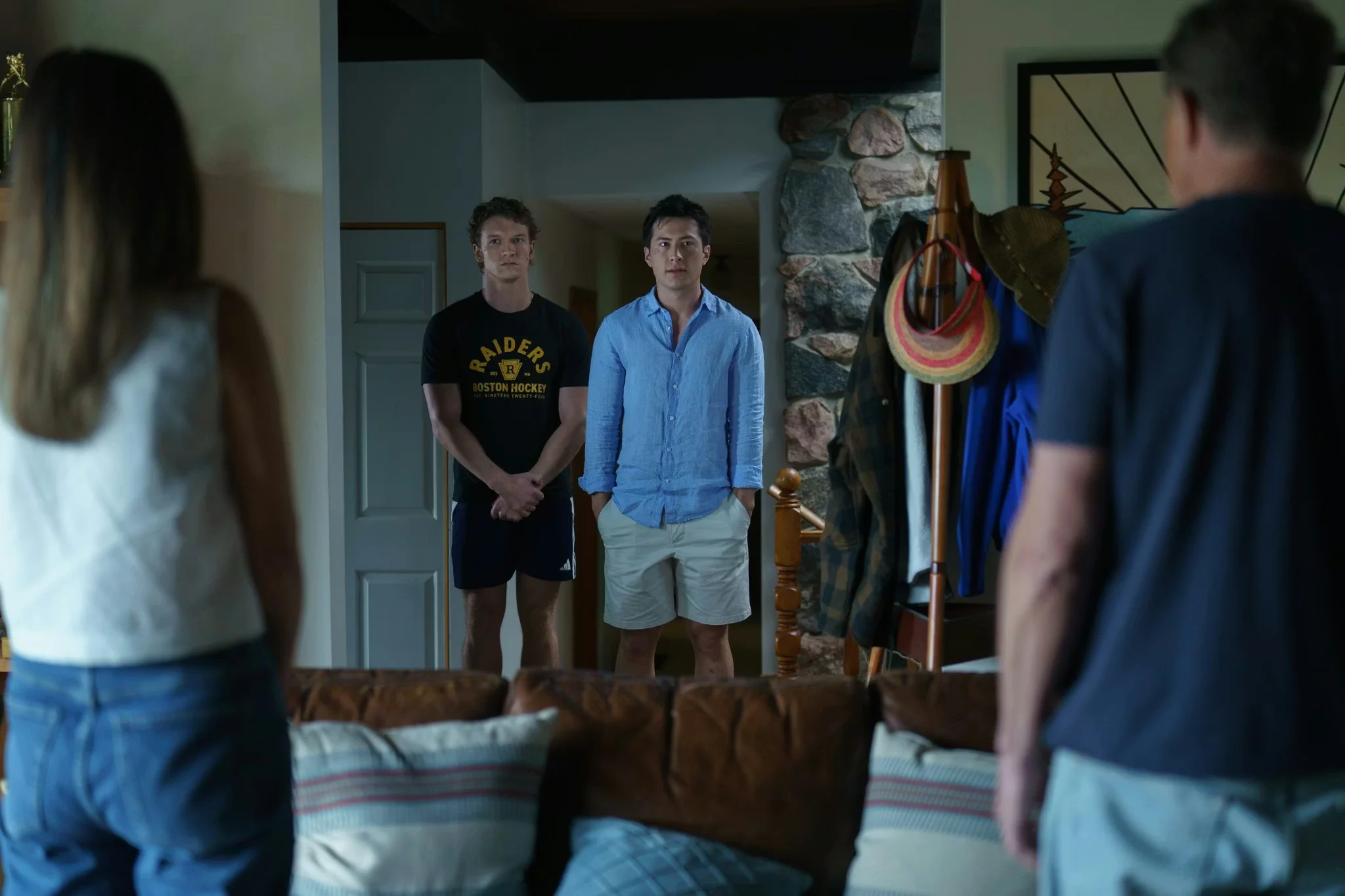
Then Shane's father David arrives unexpectedly to collect a phone charger and finds them kissing. He leaves without a word. Shane's worst nightmare: being discovered before he's ready, losing control of the narrative, facing his parents' knowledge without preparation.
But what actually happens is more complicated than Shane feared.
When Shane and Ilya drive to his parents' house to explain, Shane arrives ready to apologise. Ready to say he tried not to be this way. Ready to make himself small in the face of disappointment.
His mother Yuna stops him. She says he has nothing to apologise for. That she's sorry. Sorry for not making him feel safe enough to tell her. Sorry for creating an environment where he had to hide.
This moment, a parent asking for forgiveness rather than granting it, is what the show understands about the specific pain of staying closeted from people who love you. It's not usually about fear of rejection. It's about the unbearable weight of disappointing people who've invested everything in your success, who've built their lives around your potential, who love you but might not know how to love this.
Shane's been carrying that weight his entire life. The pressure to be perfect. To be successful. To never let anything interfere with hockey. He has spent years building a Fortress of Competence - using his excellence on the ice to protect himself from the terror of being a burden off it.
That's why he couldn't tell them. Not because he thought they'd reject him, but because he couldn't bear to be the one who complicated their pride in him.
When Yuna apologises, she's releasing him from that burden. She's saying: you were protecting yourself from something I accidentally created. And I'm sorry.
By the finale's end, Shane and Ilya have a plan: Ilya will move to Ottawa. They'll start a charity together, the Irina Foundation, named after Ilya's mother who died by suicide, supporting mental health and running inclusive hockey camps. They'll tell the public their rivalry has evolved into friendship. They'll be together, but bounded. Close, but structured.
It's a more sophisticated container than the rivalry, but it's still a container. Another way to regulate intimacy instead of actually having it. Another structure that lets them be seen together whilst maintaining careful distance from actual vulnerability.
The charity isn't a solution. It's a compromise. And if you're watching this thinking "at least they have something," you probably recognise the compromise because you're living your own version of it.
The person you introduce as your flatmate even though you've been sleeping in the same bed for a year. The "we're just figuring things out" when someone asks if you're together. The sophisticated way of hiding that looks like honesty.
Heated Rivalry has become a phenomenon because it's depicting something many people experience but rarely see represented: the way desire often needs structure to feel safe. The way intimacy can feel more possible when it's bounded. The way some people can only be close when there's distance.
This isn't dysfunction. It's regulation.
The obstacle isn't preventing intimacy. It's making intimacy possible by keeping it bounded. By ensuring it can't become too much, demand too much, cost too much. As long as there's something in the way, you never have to face what you'd do if nothing was in the way.
You can be passionate when there's pursuit but unsure when someone actually commits. You can want people who can't fully have you. You can be intimate in spaces that have built-in endings. You can have intense situationships but struggle when someone wants to call you their partner.
The casual thing that's not casual. The open relationship where you're functionally monogamous but won't say so. The long-distance situation where the distance is doing the work of regulating intimacy. The "we're taking it slow" when what you mean is "we're keeping this from becoming too real."
These aren't relationship styles. They're defences. And they work the same way the rivalry works: they make intimacy possible by ensuring it can't demand too much.
The real question isn't whether Shane and Ilya will stay together. It's whether desire that's been structured by opposition can survive without it.
Can people who learnt to be intimate through conflict learn to be intimate through vulnerability? Can a relationship that felt safe because it was bounded become safe when it's exposed? Can you love someone in daylight the way you loved them in hiding?
But the question isn't just for Shane and Ilya. If you're watching this show with your heart in your throat, if you wept at Scott Hunter's kiss, if you're holding your breath waiting for season two, the question is also for you.
Can you want someone without the built-in reason it can't work? Can you be intimate without the distance that makes intimacy tolerable? Can you let yourself be chosen without immediately finding a way to keep it complicated?
At some point, someone will want to come to the cottage. Someone will want to make it real. Someone will want you without the careful boundaries, without the structural reasons it can't work, without the opposition that's been keeping it safe.
And you'll have to decide: am I willing to risk the structure? Or do I need to keep my intimacy bounded?
Scott Hunter showed everyone it's possible to step out of the structure and survive. Shane and Ilya are trying to discover if they can want each other without the rivalry that made wanting safe.
The show's success suggests a lot of people are asking themselves the same question.